Understand cardiac medications instead of relying on memorization. This illustrated guide connects cardiac physiology, pathophysiology, and pharmacology to help nurses understand how common heart medications work.
Take the stress out of medication math with a simple, visual approach to drug calculations. Learn how to confidently solve dosage, IV, tablet, liquid, and weight-based calculations without relying on complicated formulas.
Learn to understand and recognize the heart sounds that can challenge nurses and nursing students. This guide focuses on the 10 most important heart sounds and explains what happens during each heartbeat and how abnormal sounds can indicate valve problems.

Note to self… buy this book, and improve your chart reading skills.
by Malcolm Rosenberg, RN
with the help of:
– I. Wright Badlee, MD
– Hugh Kant Reed, MD
– Ida Cypher Scribbles, RN
$3.95
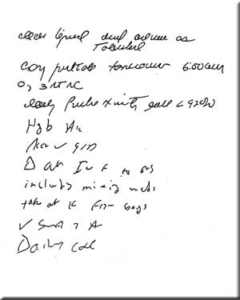
I have dealt with charts every single working day for the past fifteen years. During that time, it always seemed like there was one nurse who everyone would seek out if they were stuck. Its the nurse who could decipher any scribble, figure out why two different nephrologists were consulted on different days, or find a code status in the middle of the ER progress notes. This pamphlet will not transform you into that nurse, but it will plant the idea that chart reading is a learnable skill, that can be practiced and mastered.
Can you read this?
A straightforward guide to mechanical ventilation that helps nurses understand ventilator settings, tidal volume, FiO2, assist-control, alarms, and how ventilator settings relate to patient assessment.
Make arterial blood gases easier to understand with clear explanations, simple illustrations, and practical exercises. Learn the physiology behind pH, CO2, HCO3, oxygen saturation, and ABG interpretation without relying on memorization.
Simplify the complex process of blood clotting with clear explanations and visual learning. This book covers platelet aggregation, clot formation, clot breakdown, and medications used to treat clotting disorders.
Make hemodynamics easy to understand with clear explanations and visual learning. This book covers heart function, cardiac and vascular disease, pressure measurements, and Swan-Ganz catheter concepts for ICU nurses and nursing students.
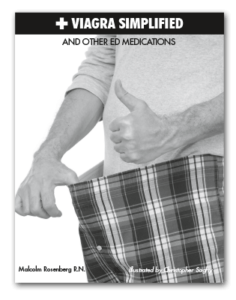 “When everybody was telling Viagra jokes, I felt the impulse to write a book explaining the subject.”
by Malcolm Rosenberg, RN & Ralph Zagha, MD
$7.95
I never said Viagra® was as important as arterial blood gases, heart sounds, hemodynamics or any of the topics covered in my nursing books. But the inspiration was the same.
A paragraph from the introduction best describes the book: “The goal of this book is to explain the physiology, pathophysiology and pharmacology of an erection. We will look at how an erection works, why sometimes problems occur and how medication and treatment can address them. If you understand how erections work, you can seek treatment more intelligently when they don’t work.”
Excerpt from Expanding Pudental Artery chapter
You may remember that Viagra®, Cialis®, and Levitra® are phosphodiesterase inhibitors. They inhibit phosphodiesterase, namely PDE5. They help establish and maintain erections by “inhibiting” phosphodiesterase from stopping the second messenger as it tries to plug the calcium channel. I know that is confusing. Pictures show it better than words.
We have a new character,
The Inhibitor.
The Inhibitor is flying through the blood stream and sees phosphodiesterase stopping cGMP plug the calcium channel. He lands on the pudendal artery…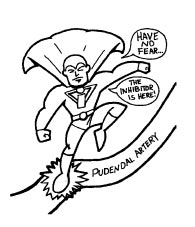
and he tells phosphodiesterase to get out of there…
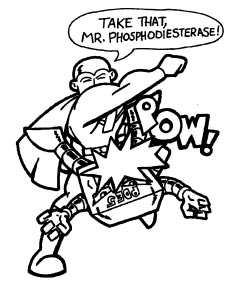
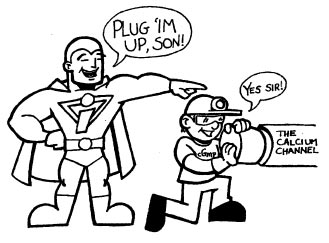
so cGmp can plug up the calcium channel. Now we have an erection.